
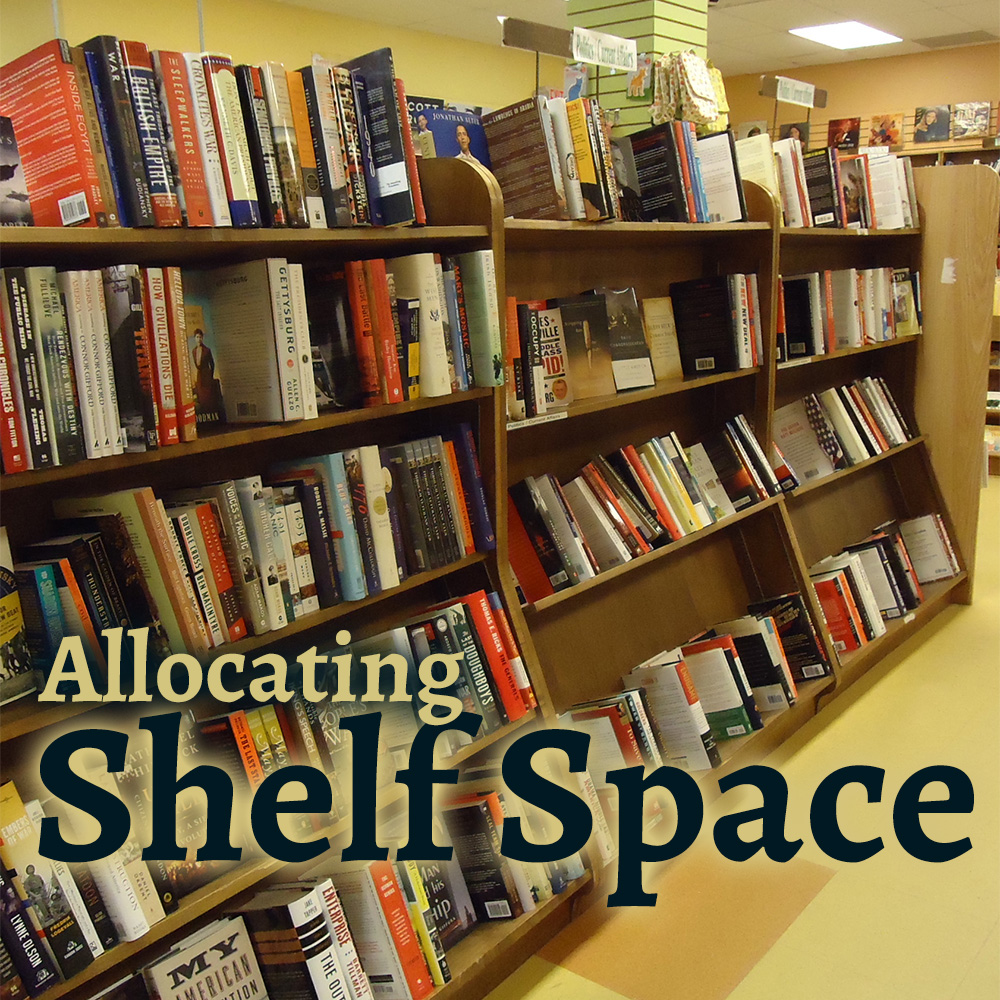
This is part 2 of a 3-part series for authors explaining how books make it into indie bookstores and which ones get the prime locations on the shelves.
Shelf Space series
- How bookstores select books
- Self-published books in indie bookstores ←
- Which books get the shelf space
So you’ve self-published a book and you’d like to put it on the shelves in brick & mortar bookstores. It can be done! Let’s take a look at how to go about it.
Make the book look good
Think ahead! When people are shopping online, they can be drawn to a book any number of different ways. The title, the concept, an online ad, a review or recommendation, a “people who looked at this book also looked at that one” link … the list is endless.
There are two solid ways to get people to pick up your book in a physical bookstore.
First, an employee handing it to them. When I first bought my store, I was trying to resolve strange peaks and dips in sales of certain titles. Then one day it hit me! On the days that Jeanne was working, we sold more copies of Tough Trip Through Paradise. When Phyllis was working, we sold more science fiction and fantasy. And so on. This is why authors should love booksellers and treat them like gold.
Second, your cover. I wrote an article for Writer’s Weekly called How to Design a Book Cover That Annoys Booksellers. Take a moment and read that now, so I don’t have to repeat it. I’ll wait. You can design a book cover yourself, but think twice before doing it. A good cover is a lot of work and it’s your #1 marketing tool in physical bookstores.
It’s not enough to make your book cover attractive. Make sure it fits the genre. There’s a certain look to middle-grade books, to romance novels, to science fiction, and so forth. If your book is a mystery, make it look like a mystery!
Once your book is in someone’s hands, what are they going to do with it next? Even before peeking inside? Look on the back. Trust me, unless you’re a celebrity, they’re not looking for a big picture of you. They’re looking for a (very) short description of what the book’s about and some blurbs. If the back cover says: “Best damned book I’ve ever read — Stephen King,” their odds of buying it just tripled.
Finally, follow all of the standards for the front matter and back matter inside the book. Make sure you have at least a half-title, copyright page, and title page up front. If you have multiple books, have a list of them alongside your “about the author” page. If your book in nonfiction, it needs an index, table of contents, and a bibliography.
In short, if you want bookstores to treat your self-published book like a traditionally-published book, make it look like one!
More to consider before publishing
How will you be distributing the book? Stores like Barnes & Noble have dedicated buyers ordering thousands of copies at a time. Your local indie shop most likely buys the majority of their books from distributors like Ingram rather than trying to deal with dozens or hundreds of different publishers.
If you tell a bookstore that they can only get the book directly from you, that’s a big barrier to overcome. A local bookshop may be okay with you stopping by on a regular basis to see what they need, but if you want to sell in bookstores hundreds or thousands of miles away, that won’t work.
I used to order pretty much every day from Ingram. It was a lot easier to convince me to carry your book if I could just add it to my daily Ingram order instead of jumping through hoops to track and order it.
Also, booksellers appreciate getting an early look at upcoming books. It’s well worth your time to print some ARCs (Advance Reader Copies) and send them out to key bookstores, bloggers, and reviewers. If you can, print those with a special cover that says “Advance Reading Copy—Not for resale” and put information about the release date, distributors that will be carrying the book, and any planned events or book tours (more on that in a moment).
If you know some prominent authors in your genre, send them ARCs as well. Ask for a blurb. They may well say no, but as my father used to tell me, they can’t say yes if you don’t ask!
When the release date approaches and your final edits are all in place, switch the ARC cover for the final cover and put some great blurbs on the back cover if you got any.
Think carefully about any promo items you send out with the books. I had several authors send me stacks of bookmarks, stickers, or pins that had a big prominent Amazon logo on them. They went straight in the trash. I don’t advertise for competitors!
If you want to have sourcing on a promotional bookmark, sure you can include Amazon, but make sure you include BookShop.org as well. That’s a nonprofit site that strongly supports indie bookstores. It’s a great place to set up your own personal bookshop page, too!
Your friendly neighborhood indie bookshop
If you’re lucky enough to have an indie bookstore close to you, they can be your best friends as an author. You definitely don’t want to be a pain in the neck, though, and under no circumstances should you act entitled. They don’t owe you shelf space!
When I owned my store, I tried to carry books from local authors when I could, because I feel like authors and booksellers have a symbiotic relationship. When I stocked a book by a local author, their friends would come in to buy it and often bought other books while they were there.
Don’t just ask the store to stock the book, though. Get them involved. Ask if they’d be willing to host a book launch party, reading, or signing. Offer to promote the event (and their store!) with posters and posts on your social media, your website (if you don’t have one, do that now!), and your blog if you have one. Do your best to get announcements on radio, TV, and local podcasts, too.

Don’t expect the store to do all the work for your book launch, though. They’re doing you a favor. Do one for them. Tell them you’ll arrange some snacks, and that you’ll invite all your friends. Offer to design the posters. It’s your event. Make it shine! I have lots of suggestions for this in my book, Gary’s Guide to Successful Book Signings. If you follow that link, note that it lets you buy on either BookShop or Amazon, and directs you to Goodreads to leave a review, too.
Timing is everything
Book promotion is very time-sensitive. Stores want to show the newest, latest, greatest stuff. It’s much harder to arrange events for old books.
Most applications for book awards require the book to have been published in the last six months, or a year at the most. Many of them appreciate getting an application along with an ARC before the book is even out. This gives you the potential opportunity to push the award on the book cover.
If you decide to wait until sales taper off and then start your promotion, you’ll find two things:
- Sales won’t taper off because there won’t be many sales in the first place if you don’t do the promotion up front.
- Promotion will be much more difficult when your book’s been out for a while.
Good luck with your book. May it be face-out in every bookstore in the country!
The next article in this series will cover which books get the prime locations on shelves in bookstores.
 Gary D. Robson