
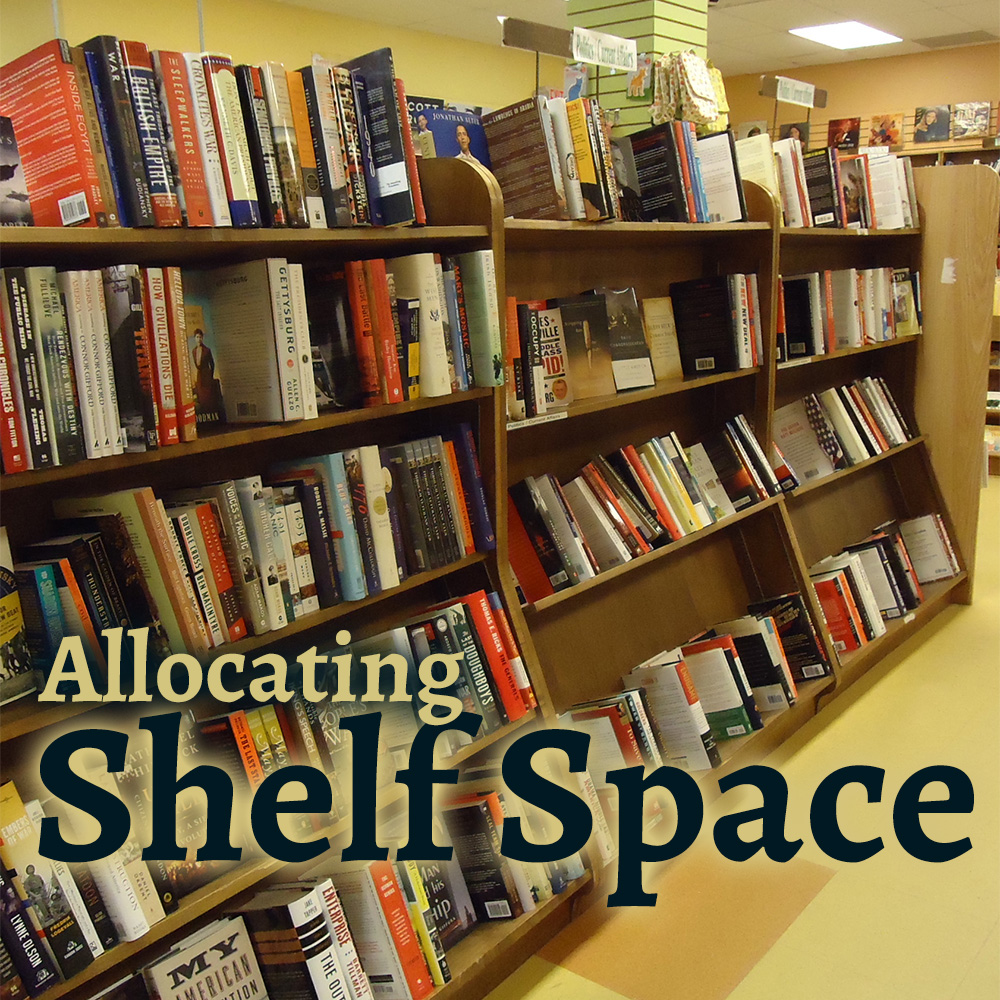
This is part 1 of a 3-part series for authors explaining how books make it into indie bookstores and which ones get the prime locations on the shelves.
Shelf Space series
- How bookstores select books ←
- Self-published books in indie bookstores
- Which books get the shelf space
In today’s publishing world, authors must have an understanding of how books are marketed and sold. Unless your name happens to be John Grisham or James Patterson, you are responsible for helping to market and sell your books.
Marketing and selling are two very different things. Marketing is a one-to-many proposition. Putting on book signings and readings, making book trailer videos, creating and maintaining a website, being visible on social media, and doing interviews—all of these are marketing.
Sales is one-on-one. Talking to someone about a book, putting it in their hands, and convincing them to buy it. Everyone who works in a bookstore knows that once a customer is actually holding a copy of a book, their chances of buying it have increased greatly. And no bookseller can put a book in someone’s hands if they don’t have it in stock in the bookstore.
During my 15 years of owning a bookstore and over 25 years as an author, I’ve heard many authors lamenting the fact that their book isn’t on the shelves in bookstores, or that it’s tucked away in a corner somewhere. They want the books to be visible; they just don’t know how to get there.
Where bookstores find new books
It’s impossible for a store to stock every book in print. The average indie bookstore will have perhaps 5,000 to 25,000 different titles in stock. A big chain store like a Barnes & Noble may have 100,000 to 150,000.
Each month, traditional publishing houses release 40,000 to 80,000 new titles. Self-published titles and vanity presses put out a staggering 200,000 or more per month.
There are more new books released every month than would fit in a large chain bookstore! How on earth can an indie store decide what to carry?
History
First, they take advantage of the historical sales information for the store. What sold well last year may not sell this year, but there are titles you can always count on. My bookstore, for example, was located in a small town in the Beartooth mountains northeast of Yellowstone National Park. Every single year, I could count on selling stacks of hiking books for the Beartooths and Yellowstone (and Yellowstone children’s books, of course!). Local history sold steadily. Some classics could be counted on, but not others.
Being an author myself, I always kept a rack of my own books near the front. Hey, it was my store, right? Indie bookstores always reflect the personality of the owners and/or managers.
The point-of-sale system in the store did a good deal of work for me. Every book had a desired stock level and a reorder point. Every day, I would tell the system to automatically generate restock orders for me. For any book that was below the order point, the order would have enough copies to bring me up to the stock level.
For example, let’s say I wanted to keep 8 copies of Walter the Farting Dog in stock, but never have fewer than 4 on hand. If I had 3 left, the system would put 5 copies on the order. When I reviewed the order, I’d look at recent sales history. Perhaps Walter was selling well last year, but only sold six copies in the last six months. I’d change the desired stock level to 3, make the reorder point 1 or 2, and remove the book from this order.
Adding new titles
Here’s the fun part! To run a bookstore, you have to keep up on the new releases. That involves a lot of research. I’d keep my eye on social media, regularly check for upcoming releases from authors that were popular in my store, and see what new books were getting a lot of buzz. That’s not enough, though. Booksellers rely on a lot of other sources.
Bestseller lists are a good starting point, but only the applicable ones. There are a lot of bestseller lists out there, but not all of them are significant for every store. The American Booksellers Association (ABA) puts out the Indie bookseller lists. Yes, that’s “lists,” plural. They have seven of them.
Generally, I would stock everything on the paperback and children’s lists along with the top five from the hardback lists (hardbacks didn’t sell as well in my store). I’d read through all of them, though, just to be sure.
ABA is the trade association for independently-owned bookstores. There are also eight regional bookseller associations in the U.S. My location, Montana, is covered by two of them, the Mountains & Plains Independent Booksellers Association (MPIBA) and the Pacific Northwest Booksellers Association (PNBA).

Montana’s taste in books tends to align better with MPIBA, which covers the states that border Montana and south through the Great Plains. I’d order just about anything on their lists. PNBA, as you might expect, had a lot more books relating to the Pacific Northwest that didn’t sell so well in Montana, but I reviewed their lists as well and got some gems there!
Other bestseller lists, like New York Times, Publisher’s Weekly, and Amazon, were a great place to get ideas, but not always appropriate for my store. The NYT list, for example, has a strong urban focus that didn’t do as well out here in the country. The Amazon list changes fast and can often reflect discounts and other factors.
The next source of ideas is book reps, catalogs, and trade publications. The sales people I dealt with at various publishing houses got to know us and what worked in my store, and they were always happy to give recommendations.
Our customers and staff were always a great resource. If three customers came in and asked for a particular book, it might be worth having. Employees could recommend just about anything and I’d give it a try, because I knew they’d be out there promoting it to customers.
Any decent local bookstore will be aware of what book clubs and reading groups exist in the area. Often, they’ll sponsor groups, give them a place to meet, or post lists of what they’re reading. It’s also common for bookstores to offer a discount on whatever the book club is reading.
Considerations for stocking a book
While most bookstores will happily special order anything, deciding whether to dedicated valuable shelf space to a new book involves some other factors.
First, does it fit the store? No matter how well the latest vampire romance is selling, the children’s bookstore down the street isn’t going to carry it.
Does it have an attention-getting cover? A good cover design can get a book that coveted face-out positioning. A bad cover can prevent the store from ordering it in the first place. If you don’t have cover design experience, you should think twice before designing your own cover.
Is it available through major distributors like Ingram and Baker & Taylor? As I mentioned above, we placed orders almost every day, especially during the busy season. But only with the distributors. If there was a publisher we bought a lot of books from, like Simon & Schuster or Penguin Random House, we might order weekly. We only ordered from some of the small publishers a couple of times a year, often right after a book show. Why? Because there are often minimum order quantities to get free shipping or better discounts, and we didn’t sell enough of their books to justify ordering more frequently. If there was only one title I was interested in from a particular publisher, I generally wouldn’t buy it at all unless it was a huge seller.
Many stores won’t stock oversized books that don’t fit on the shelves in their section, very thin books with nothing on the spine, tiny books that are easy to shoplift, or books without barcodes. There are exceptions to this, of course, but those books have to be pretty special to get stocked.
There are some publishers that are just a pain to deal with. There was one called PublishAmerica back in the day that published books for a couple of local authors. They were such a pain to deal with that I finally had to tell the authors to order the books for me or I wouldn’t carry them. Amazon has bought a lot of vanity presses and small publishers and made them very difficult for bookstores to deal with. I wouldn’t order from most of them, either.
If you want some insight into the economics of running a bookstore, take a look at Bookselling by the Numbers, a talk I gave at MPIBA. I don’t have the full text of my presentation online, but you can follow the link for an overview and download my slides from there if you wish.
The next article in this series will cover selling self-published books in bookstores. Yes, it’s possible to get a self-published book stocked, but it takes some work.
 Gary D. Robson